
Most parents start the search by asking friends who their teenager sees, or by typing a search into Google and calling the first result that looks credible. Neither of those approaches is wrong exactly, but both skip the questions that actually separate a good decision from a convenient one. Choosing an orthodontist for a teenager is not the same as choosing one for a younger child or for yourself. The clinical scope is broader, the treatment window is developmentally specific, and the compliance demands of treatment fall primarily on the teenager rather than the parent. Getting those dimensions right before committing to a one-to-two year treatment course is what this guide is for.
Key Takeaways
- Orthodontists in Canada are certified dental specialists who have completed an additional two-to-three year residency program after dental school. The Canadian Dental Association recognises Orthodontics and Dentofacial Orthopedics as one of nine sanctioned dental specialties. Not every provider offering orthodontic services holds this designation.
- Dentofacial orthopedics, the guidance of facial growth and development through specialised appliances, is distinct from tooth movement and is a clinical capability that matters for teenagers whose jaw development is still in progress.
- Guildford Orthodontic Centre offers In-Ovation self-ligating precision braces in three configurations, translucent cosmetic braces, coloured braces, and Invisalign Teen for adolescent patients.
- Digital radiography at Guildford reduces radiation exposure compared to traditional X-ray processing and eliminates the harsh chemicals associated with conventional film development.
- Complimentary consultations and second opinions are both welcome. The practice is open Monday through Saturday from 8am to 5pm at 10203 152A Street, Suite 200, Surrey BC.
Table of Contents
In Canada, the path to becoming a dentist and the path to becoming a specialist orthodontist are not the same. Every orthodontist completes dental school first. Then, only those who pursue an additional two-to-three year residency program in orthodontics become certified specialist orthodontists. The Canadian Dental Association recognises nine dental specialties, and Orthodontics and Dentofacial Orthopedics is one of them.
The practical implication is that general dentists can legally offer some orthodontic services, including clear aligner treatment from various providers, without completing a specialist residency. A parent searching for orthodontic care in Surrey will encounter both categories of provider, and the distinction is not always obvious from a website or a consultation conversation.
What the specialist residency provides is two things: comprehensive training in the full range of orthodontic and dentofacial treatment, including complex bite correction and cases that require more than tooth movement, and supervised clinical exposure to a volume and variety of cases that general continuing education courses cannot replicate. For a straightforward alignment case, this distinction may matter less. For a teenager whose bite has structural components beyond crowding or spacing, it matters considerably.
Guildford Orthodontic Centre's orthodontists are trained in both orthodontics and dentofacial orthopedics, meaning they can diagnose jaw misalignments and facial structural issues alongside tooth positioning and develop treatment plans that address both dimensions where required.
What dentofacial orthopedics means and why it matters for teenagers specifically
The word orthodontics comes from the Greek roots for straight and teeth. Dentofacial orthopedics adds the Greek words for face and child, and the name describes the discipline accurately: it is the guidance of facial growth and development, which occurs mostly during childhood and adolescence.
Orthodontics manages tooth movement. Dentofacial orthopedics manages the skeletal framework those teeth sit in. When a teenager has a bite problem rooted in jaw position rather than tooth position, moving teeth alone does not resolve the underlying structural issue. It addresses the visible symptom while the cause continues.
Specialised appliances including expanders and headgear are used in orthopedic treatment, sometimes in anticipation of conventional braces and sometimes simultaneously with them. The growth that is still occurring during the teenage years is the clinical opportunity that makes orthopedic intervention meaningful. Once jaw development is complete, modifying the skeletal structure requires surgical intervention. The teenage window is when the non-surgical path is still available.
A practice equipped to deliver dentofacial orthopedics alongside conventional braces and aligners is not treating the same scope as a practice that offers alignment correction alone. For parents whose teenager presents with jaw discrepancy signs, this distinction is clinically significant. For those whose teenager has straightforward alignment needs, it means the practice has the diagnostic depth to confirm that no structural issues are being missed before committing to a treatment path.
What self-ligating brackets actually do differently and why it matters for a teen patient
One of the questions parents rarely ask but should is what type of bracket system the practice uses for fixed braces, and what the clinical rationale is for that choice.
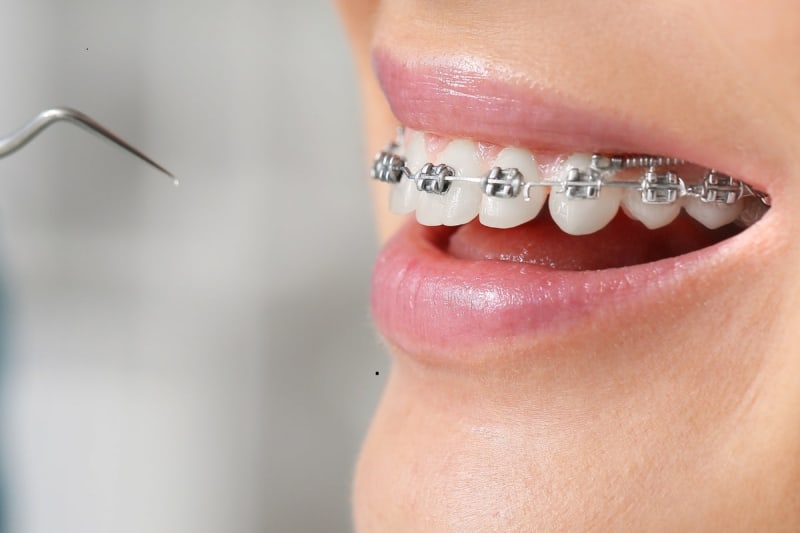
Conventional metal brackets hold the archwire in place using small elastic ties or metal ligature wires. These create friction at the bracket-wire interface. The wire moves through the bracket against resistance, which places additional force on the teeth and the periodontal ligament at every point in the movement sequence.
In-Ovation Precision Braces at Guildford Orthodontic Centre are self-ligating. The bracket contains an integrated clip that holds the archwire without elastic ties, which eliminates the friction point. The wire engages and disengages through a passive mechanism rather than being held under tension by elastic material. This is not a cosmetic distinction. It changes how force is delivered to the teeth across the treatment period.
For a teenager specifically, the practical effects are relevant. Guildford notes that In-Ovation patients commonly experience less friction against the inside of the mouth due to the smaller bracket profile, which makes day-to-day wearing more comfortable. Routine oral hygiene around brackets without elastic tie attachments is also simpler, which matters across a treatment course where consistent cleaning directly affects oral health outcomes.
In-Ovation comes in three configurations: In-Ovation R, a small low-profile metal bracket with no elastic or metal ties; In-Ovation C, a translucent ceramic self-ligating bracket combining the mechanical advantages of self-ligation with a tooth-coloured aesthetic; and In-Ovation L MTM, designed for patients requiring six millimetres of movement or less as a limited treatment option. The orthodontist determines which configuration is clinically appropriate after a full examination.
How to evaluate clinical technology as a parent who is not a clinician
Parents are not expected to arrive at an orthodontic consultation with a working knowledge of bracket systems or imaging protocols. But understanding what the technology at a practice is designed to do, and why it matters for a patient who will be attending regular appointments across one to two years, is a reasonable and useful frame for evaluating one practice against another.
Digital radiography is the imaging standard at Guildford Orthodontic Centre. The clinical case for digital over conventional film X-ray has two components that are directly relevant to a teenage patient. First, digital systems use substantially lower radiation doses than conventional film-based processing. For a teenager who will have multiple sets of images taken across a multi-year treatment period, the cumulative reduction in radiation exposure has genuine clinical significance. Second, digital systems avoid the chemical processing associated with traditional X-ray film, which is both an environmental consideration and a practice quality indicator.
The paperless integration of computer systems at Guildford means patient information is accessible at every chair in the practice instantly. For a parent, this translates practically: records do not need to be retrieved, scanned, or communicated between rooms, and the orthodontist reviewing the teenager's case at any appointment has access to the complete clinical picture without delay.
These are not luxury features. They reflect the standards a practice has chosen to build to, which signals something about how that practice approaches care quality generally.
What sterilisation standards signal about a practice's commitment to patient safety
No parent wants to think about sterilisation protocols at an orthodontic office. They are also one of the clearest signals available about how seriously a practice takes patient safety at every level.
At Guildford Orthodontic Centre, all instruments are packed in delivery cassettes and autoclaved before each use. An autoclave is a pressurised medical device that uses steam under pressure to destroy all types of microorganisms, and it is considered one of the most effective sterilisation methods available in clinical settings. Every instrument arrives at the patient chair packaged and sterile, and is unwrapped in front of the patient.
The independent lab verification component is what separates a robust sterilisation protocol from a standard one. Guildford's constant sterilisation monitoring system is independently verified, meaning a third party confirms the autoclave is performing to specification rather than the practice simply testing and reporting its own results. For a teenager attending appointments regularly over one to two years, this matters at a baseline level that most parents do not think to ask about and should.
The compliance question: why the teenager's relationship with the practice matters
Orthodontic treatment outcomes are partially clinically determined and partially patient-determined. The clinical decisions, bracket placement, wire sequencing, appliance selection, bite correction mechanics, are the orthodontist's responsibility. The daily decisions, wearing elastics consistently, maintaining hygiene around brackets, avoiding foods that damage appliances, attending every appointment, are the teenager's.
A teenager who does not have a functional relationship with the practice, who dreads appointments, does not feel heard, or does not understand what is being asked of them and why, is a compliance risk. And compliance failures in orthodontics extend treatment, compromise results, and in some cases require retreatment.
The consultation is the best available signal of this fit. Not how efficiently it runs or how impressive the technology looks, but whether the orthodontist communicates with the teenager directly, explains the treatment plan in terms the teenager can engage with, and creates an environment where a sixteen-year-old with opinions and questions can actually express them. A teenager who leaves the consultation feeling informed and involved cooperates differently across the following months than one who was spoken around.
Guildford Orthodontic Centre offers a virtual consultation option for families who want a lower-pressure entry point before committing to the full in-person assessment. It is a practical way for a teenager to engage with the process on their own terms before showing up at an office.
What parents consistently overlook when comparing practices
Three things come up in almost every orthodontic decision conversation that are less important than parents assume, and three things that are more important.
Less important than assumed: the physical appearance of the waiting room, the proximity of the office to home versus school, and whether the practice has the most reviews online. None of these predict clinical quality.
More important than parents typically investigate: whether the practice is led by certified specialist orthodontists rather than general dentists offering aligner treatment, what the full scope of treatment technology the practice uses is and whether the orthodontist can explain the rationale for it, and what the practice's approach is when something goes wrong mid-treatment, a broken bracket, a lost aligner, an unexpected clinical development.
On the last point, Guildford Orthodontic Centre includes everything needed across the full treatment course in the comprehensive treatment fee: beginning and final records, all X-rays, all appliances, upper and lower retainers, and all orthodontic supplies including toothbrushes, fluoride rinse, brushing timer, sports mouth guards, and orthodontic floss. The practice also continues to follow each patient after the completion of active treatment. Understanding what a fee actually covers before signing on is one of the most practical things a parent can do before making a final decision.
The payment calculator on the Guildford website provides a starting point for cost estimation. The financial considerations page covers payment arrangement options for families who need flexibility across a multi-year treatment course.
Teen Orthodontist Checklist: 10 Questions to Ask at the Consultation
Arriving at a consultation prepared makes the appointment significantly more useful. Before committing to any practice or treatment plan, have these questions ready — and make sure your teenager is present for the visit.
1. Are you a certified specialist orthodontist, or a general dentist offering orthodontic services?
2. Is this practice trained in dentofacial orthopedics, and does my child's case require it?
3. What type of bracket system do you use for fixed braces, and why do you use that system?
4. Is Invisalign Teen clinically appropriate for my child's specific case?
5. What is the full scope of what is included in the treatment fee?
6. What is the expected treatment duration, and what factors could extend it?
7. How frequently will appointments be needed, and how long is each visit?
8. What happens if a bracket breaks, an aligner is lost, or we need to reschedule an appointment?
9. Is a second opinion welcome if we want to compare treatment recommendations?
10. What does the practice do after treatment is complete — is there ongoing retention monitoring?
At Guildford Orthodontic Centre, all of these questions are addressed at the complimentary first consultation. The visit is no-obligation and second opinions are explicitly welcomed.
Frequently Asked Questions
What is the difference between an orthodontist and a dentist who offers braces or Invisalign?
An orthodontist is a certified dental specialist who has completed an additional two-to-three year residency in orthodontics after dental school. General dentists can offer some orthodontic services through continuing education training but have not completed specialist residency. For complex teen cases involving bite correction or jaw discrepancies, the depth of specialist training is clinically relevant.
What does dentofacial orthopedics add to a teenager's treatment that braces alone cannot?
Braces move teeth. Dentofacial orthopedics addresses the jaw structure those teeth sit in. When a teenager's bite problem has a skeletal component, orthopedic appliances guide jaw development during the growth window. Once growth is complete, modifying jaw structure requires surgical intervention. The teenage years are when orthopedic treatment is still an option.
What are the three In-Ovation configurations and which is appropriate for a teenager?
In-Ovation R is a small low-profile metal self-ligating bracket. In-Ovation C is a translucent ceramic self-ligating bracket combining aesthetics with the mechanics of self-ligation. In-Ovation L MTM is designed for limited treatment requiring six millimetres of movement or less. The appropriate configuration is determined by the orthodontist after a full clinical examination, not by patient preference alone.
Is a second opinion appropriate before committing to a teenager's orthodontic treatment?
Yes, and Guildford Orthodontic Centre specifically welcomes second opinion requests. For a treatment course spanning one to two years and involving a significant financial and lifestyle commitment for the family, getting a second clinical perspective before proceeding is a reasonable and well-regarded practice.
Conclusion
The right orthodontist for a teenager in Surrey is not necessarily the closest, the most reviewed, or the one a neighbour mentioned. It is the practice whose clinical capabilities match what the teenager's case actually requires, whose team communicates in a way the teenager can engage with, and whose standards of technology and sterilisation reflect a consistent approach to patient care that will hold up across every appointment over the next year or two.
Guildford Orthodontic Centre brings specialist orthodontic and dentofacial orthopedic training, self-ligating precision bracket technology, digital radiography, and independent sterilisation verification to every patient who walks through the door. Book your teenager's complimentary consultation at Guildford Orthodontic Centre in Surrey. No obligation. No pressure. Just answers about what your teenager's smile needs.